
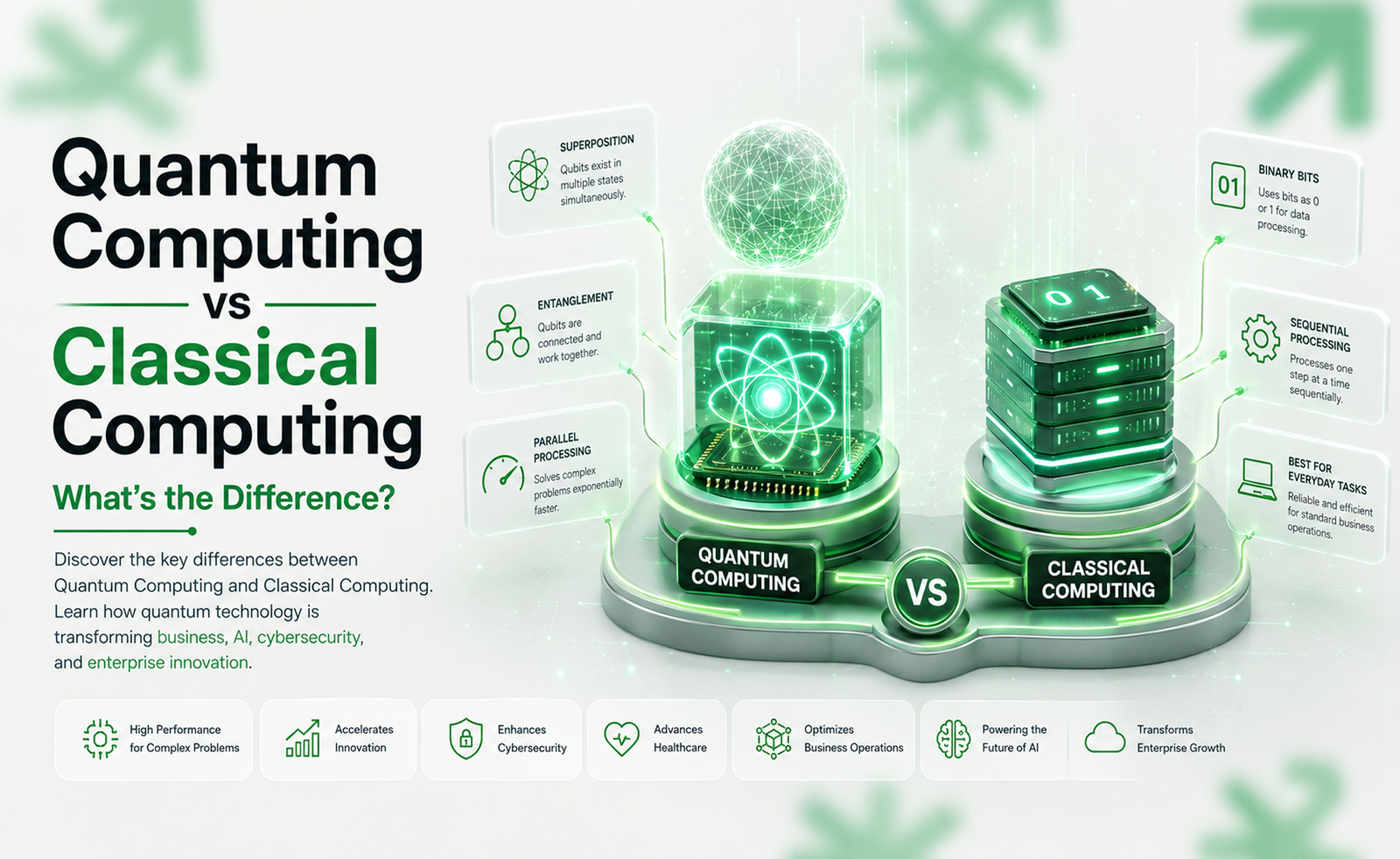
Computing technology has transformed the way businesses operate, powering everything from cloud computing and enterprise software to artificial intelligence and digital automation. For decades, Classical Computing has been the foundation of modern technology, enabling organizations to process data, automate workflows, and drive innovation efficiently.
As businesses generate larger volumes of data and tackle increasingly complex challenges, traditional computing is approaching its practical limitations. This has led to the rise of Quantum Computing—a next-generation technology that uses quantum bits (qubits) to solve certain computational problems far more efficiently than classical computers.
Although Quantum Computing is still in its early stages, it has the potential to revolutionize industries such as healthcare, finance, cybersecurity, logistics, and scientific research. Understanding the differences between Quantum Computing and Classical Computing is essential for organizations preparing for the future of digital innovation.
At Shweta Technologies , we help businesses embrace emerging technologies through innovative software solutions and digital transformation strategies that support long-term growth.
What is Classical Computing?
Classical Computing refers to the traditional method of processing information using binary bits. Every piece of data is represented as either 0 or 1, and processors perform calculations by following predefined logical operations.
Today’s laptops, desktops, smartphones, cloud servers, and enterprise systems all rely on classical computing. Over the years, this technology has become faster, more reliable, and capable of handling billions of calculations every second.
Classical computers are highly effective for everyday business operations, including:
- Business software applications
- Web and mobile development
- Database management
- Financial transactions
- Cloud computing
- Enterprise Resource Planning (ERP)
- Customer Relationship Management (CRM)
- Artificial Intelligence applications
Despite their impressive performance, classical computers solve problems sequentially and may require significant time to process highly complex calculations involving massive datasets.
What is Quantum Computing?
Quantum Computing is an advanced computing technology that uses the principles of quantum mechanics to process information in entirely different ways from classical computers.
Instead of using binary bits, quantum computers use qubits, which can exist in multiple states simultaneously through a phenomenon known as superposition. Quantum computers also leverage entanglement, allowing qubits to work together in ways that dramatically increase computational capabilities for specific types of problems.
Rather than replacing classical computers, quantum systems are designed to solve highly complex challenges that are difficult or impractical for conventional machines.
Potential Applications of Quantum Computing
- Drug discovery
- Financial modeling
- Climate simulations
- Logistics optimization
- Artificial Intelligence
- Cryptography
- Scientific research
- Advanced manufacturing
Although commercial quantum computing is still developing, it represents one of the most promising technologies for the future of enterprise innovation.
How Quantum Computing Differs from Classical Computing
While both technologies are designed to process information, they operate using fundamentally different principles.
| Classical Computing | Quantum Computing |
|---|---|
| Uses binary bits (0 or 1) | Uses quantum bits (qubits) |
| Sequential processing | Parallel quantum processing |
| Best for everyday computing | Best for highly complex computations |
| Mature and widely available | Emerging technology |
| Fixed logical operations | Quantum mechanical principles |
| Limited by processing power | Extremely powerful for specialized problems |
| Reliable for standard business tasks | Designed for advanced scientific and enterprise challenges |
| Lower implementation cost | High research and infrastructure investment |
The most significant difference lies in how information is processed. Classical computers evaluate one state at a time, while quantum computers can evaluate multiple possibilities simultaneously, making them exceptionally powerful for solving optimization, simulation, and complex mathematical problems.
Benefits of Classical Computing
Classical Computing continues to be the foundation of modern digital infrastructure and remains the preferred choice for most business applications.
Key Benefits
- Reliable and proven technology
- Cost-effective infrastructure
- Fast performance for everyday tasks
- Extensive software compatibility
- Easy deployment and maintenance
- Strong cybersecurity ecosystem
- Global hardware availability
- Well-established developer community
For daily business operations such as accounting, communication, software development, and cloud services, classical computing remains the most practical and efficient solution.
Benefits of Quantum Computing
Quantum Computing introduces capabilities that extend far beyond the limits of traditional computing.
Key Benefits
- Solves highly complex calculations significantly faster
- Optimizes large-scale business operations
- Accelerates scientific research
- Improves Artificial Intelligence and Machine Learning
- Enhances financial modeling and risk analysis
- Supports advanced cybersecurity research
- Enables breakthrough discoveries in healthcare
- Handles massive datasets more efficiently
- Opens new possibilities for enterprise innovation
As quantum hardware continues to mature, businesses are expected to unlock entirely new opportunities for solving problems that were previously considered impossible using conventional computing.
Although Quantum Computing is still an emerging technology, businesses across various industries are actively exploring its potential to solve complex problems that are beyond the capabilities of classical computers. As quantum hardware continues to advance, organizations are expected to integrate quantum computing into specialized business operations to improve efficiency, innovation, and decision-making.
Business Applications of Quantum Computing
Although Quantum Computing is still an emerging technology, businesses across various industries are actively exploring its potential to solve complex problems that are beyond the capabilities of classical computers. As quantum hardware continues to advance, organizations are expected to integrate quantum computing into specialized business operations to improve efficiency, innovation, and decision-making.
Healthcare
Quantum Computing has the potential to revolutionize healthcare by accelerating drug discovery, analyzing complex genetic data, simulating molecular interactions, and supporting personalized treatment planning.
- Drug discovery and pharmaceutical research
- Genomic data analysis
- Molecular simulations
- Personalized medicine
- Medical research acceleration
Banking & Financial Services
Financial institutions are researching quantum technology to improve financial modeling, optimize investment strategies, and strengthen risk management.
- Risk analysis
- Portfolio optimization
- Fraud detection
- Financial forecasting
- Investment modeling
Logistics & Supply Chain
Quantum algorithms can help businesses optimize complex logistics operations by evaluating millions of possible scenarios simultaneously.
- Delivery route optimization
- Inventory planning
- Warehouse management
- Supply chain forecasting
- Transportation efficiency
Manufacturing
Manufacturers can use Quantum Computing to optimize production processes, improve product quality, and reduce operational costs through advanced simulations.
- Production optimization
- Material research
- Product design simulations
- Predictive maintenance
- Industrial process improvement
Artificial Intelligence
Quantum Computing has the potential to significantly enhance Artificial Intelligence by processing massive datasets more efficiently, improving machine learning models, and solving optimization challenges that are difficult for classical computing systems.
- Large-scale machine learning
- Advanced neural network optimization
- AI model training
- Predictive analytics
- Big data processing
Although widespread commercial adoption is still developing, these applications demonstrate the enormous potential of Quantum Computing across modern industries.
Industries Expected to Benefit the Most
As Quantum Computing technology matures, several industries are expected to experience significant transformation by solving computational problems that are impossible or impractical for traditional computers.
These industries include:
- Healthcare
- Banking & Financial Services
- Pharmaceuticals
- Manufacturing
- Logistics & Supply Chain
- Telecommunications
- Aerospace
- Automotive
- Energy
- Artificial Intelligence
- Scientific Research
- Cybersecurity
Organizations operating in these sectors can leverage Quantum Computing to accelerate innovation, solve complex computational problems, and gain a competitive advantage in an increasingly data-driven world.
Challenges of Adopting Quantum Computing
Despite its promising future, Quantum Computing remains a developing technology with several challenges that businesses should consider before adoption.
Key Challenges
- High implementation costs
- Limited commercial hardware availability
- Complex programming requirements
- Need for specialized expertise
- Error correction limitations
- Integration with existing systems
- Security and regulatory considerations
- Infrastructure requirements
- Long-term research investment
For most businesses, Quantum Computing will complement rather than replace Classical Computing. Hybrid computing models that combine the strengths of both technologies are expected to become increasingly common as the technology evolves.
The Future of Quantum Computing
Quantum Computing is expected to become one of the most transformative technologies of the coming decade. As hardware improves and practical applications expand, businesses will increasingly use quantum systems to solve challenges that are currently beyond the reach of traditional computing.
Future Developments May Include
- Faster scientific discoveries
- Advanced Artificial Intelligence
- Quantum-enhanced cybersecurity
- Smarter financial modeling
- Autonomous industrial optimization
- Improved climate simulations
- Next-generation healthcare research
- Enterprise quantum cloud services
- Hybrid classical-quantum computing environments
While Classical Computing will continue to power everyday business operations, Quantum Computing will open new possibilities for solving highly complex computational problems and driving innovation across industries.
How Shweta Technologies Helps Businesses Embrace Emerging Technologies
At Shweta Technologies , we help organizations stay ahead of technological advancements by delivering innovative digital solutions that support business growth and long-term digital transformation.
Our team works closely with startups, SMEs, and enterprises to identify emerging technologies, build scalable software solutions, and prepare organizations for the next generation of digital innovation. Whether your business is looking to adopt Artificial Intelligence, automate operations, or explore future-ready technologies like Quantum Computing, we provide strategic guidance and end-to-end technology implementation.
Our Services
- Custom Software Development
- Artificial Intelligence (AI) Solutions
- Enterprise Software Development
- Web & Mobile Application Development
- Digital Transformation Consulting
- Cloud Solutions
- Business Process Automation
- Emerging Technology Advisory
- Technology Strategy Consulting
- Future-Ready Digital Solutions
From enterprise applications and intelligent automation to cloud-based platforms and AI-powered software, Shweta Technologies develops secure, scalable, and innovative solutions that help businesses remain competitive in a rapidly evolving digital landscape.
Why Choose Shweta Technologies?
Businesses partner with Shweta Technologies because we combine technical expertise with a strong understanding of modern business challenges. Our focus is on delivering practical, scalable, and future-ready digital solutions that generate measurable business value.
Why Businesses Trust Us
- Experienced software development team
- Expertise in AI and emerging technologies
- Scalable cloud-based solutions
- End-to-end digital transformation services
- Business-focused technology consulting
- Secure and high-performance software development
- Customized solutions for startups and enterprises
- Commitment to innovation and long-term business success
Our goal is to help organizations leverage the latest technologies to improve efficiency, accelerate innovation, and achieve sustainable growth.
Final Thoughts
Quantum Computing represents the next frontier of technological innovation, offering capabilities that extend beyond the limits of Classical Computing. While traditional computers will continue to power everyday business operations, quantum technology will enable organizations to solve highly complex problems in areas such as Artificial Intelligence, cybersecurity, healthcare, financial modeling, logistics, and scientific research.
Rather than replacing Classical Computing, Quantum Computing is expected to work alongside existing systems through hybrid computing environments, allowing businesses to combine the reliability of traditional computing with the extraordinary computational power of quantum technologies.
Although commercial Quantum Computing is still evolving, organizations that begin understanding and preparing for this technology today will be better positioned to drive innovation, improve decision-making, optimize operations, and gain a competitive advantage in the future digital economy.
As industries continue to embrace digital transformation, Quantum Computing is set to become one of the most impactful technologies shaping the future of enterprise innovation.
Ready to Prepare Your Business for the Future?
Whether you’re exploring Artificial Intelligence, enterprise software, cloud solutions, automation, or future technologies like Quantum Computing, Shweta Technologies can help you build secure, scalable, and innovation-driven digital solutions tailored to your business goals.
Let’s work together to transform your ideas into future-ready technology solutions.
Contact Us
Shweta Technologies LLP
Ahmedabad, Gujarat, India
📞 +91 63561 37551
✉️ shwetatechnologie@gmail.com
🌐 https://shwetatech.com/