
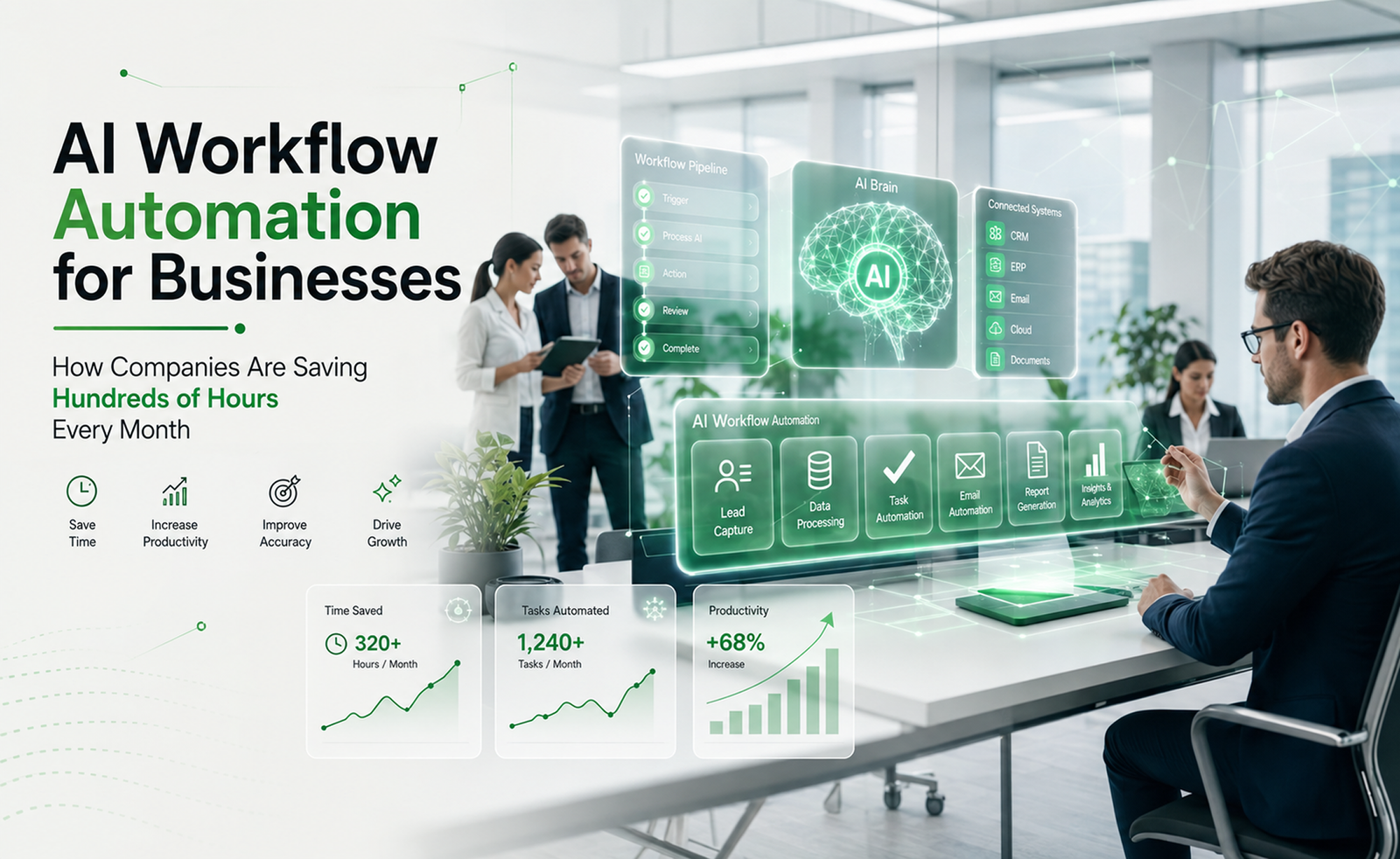
Artificial Intelligence (AI) is transforming the way modern businesses operate. As organizations handle increasing amounts of data, customer interactions, and repetitive administrative tasks, traditional workflows often become slow, inefficient, and prone to human error. To stay competitive, businesses are turning to AI Workflow Automation to streamline operations, improve productivity, and reduce operational costs.
Unlike traditional automation, which follows fixed rules, AI workflow automation can analyse data, understand patterns, make intelligent decisions, and continuously improve business processes. From automating customer inquiries and invoice processing to managing employee onboarding and sales follow-ups, AI-powered workflows help organizations complete tasks faster while allowing employees to focus on strategic and creative work.
Businesses across industries are adopting AI workflow automation not only to save time but also to enhance customer experiences, improve accuracy, and accelerate digital transformation. As AI technology continues to evolve, workflow automation is becoming an essential part of every modern business strategy.
At Shweta Technologies, we help businesses implement intelligent automation solutions that simplify operations, increase efficiency, and support long-term business growth through innovative AI-driven technologies.
What Is AI Workflow Automation?
AI Workflow Automation is the process of using Artificial Intelligence to automate repetitive business tasks, optimize workflows, and improve decision-making with minimal human intervention. Unlike traditional automation systems that follow predefined rules, AI-powered automation can analyse information, adapt to changing conditions, and make data-driven decisions in real time.
These intelligent systems combine technologies such as Machine Learning (ML), Natural Language Processing (NLP), Computer Vision, and Large Language Models (LLMs) to automate both simple and complex business processes.
Businesses commonly use AI workflow automation for:
- Customer support automation
- Email management
- Invoice and billing processing
- HR and employee onboarding
- Lead management
- Sales follow-ups
- Document processing
- Data entry and reporting
- Marketing automation
- Internal approvals and notifications
By reducing manual work and improving operational efficiency, AI workflow automation enables businesses to focus on innovation and business growth.
Why Businesses Are Adopting AI Workflow Automation
Modern businesses generate thousands of repetitive tasks every day. Employees spend valuable time responding to emails, updating spreadsheets, processing documents, scheduling meetings, and managing customer requests. These manual processes reduce productivity and increase the risk of errors.
AI workflow automation helps businesses eliminate these repetitive activities by allowing intelligent systems to complete tasks automatically and accurately.
Businesses are adopting AI workflow automation because it helps them:
- Save hundreds of working hours every month
- Reduce operational costs
- Minimize human errors
- Improve employee productivity
- Deliver faster customer service
- Increase workflow efficiency
- Enhance business scalability
- Make faster, data-driven decisions
Instead of replacing employees, AI automation empowers teams by handling routine work, allowing professionals to focus on higher-value tasks such as strategy, innovation, and customer engagement.
How AI Workflow Automation Works
AI workflow automation follows a structured process to automate business operations efficiently. It begins by collecting information from various business systems such as emails, CRM software, ERP platforms, websites, and internal databases.
The AI then analyses the data, identifies patterns, understands the context, and determines the appropriate action based on predefined business objectives. It can automatically assign tasks, generate reports, send notifications, update records, or trigger the next step in the workflow without requiring manual intervention.
A typical AI workflow automation process includes:
- Collecting data from multiple sources
- Analysing information using AI algorithms
- Making intelligent decisions based on business rules
- Executing automated actions
- Monitoring performance and learning from outcomes
- Continuously improving workflow efficiency
This intelligent approach allows businesses to automate not only repetitive tasks but also decision-based processes, making operations faster, smarter, and more scalable.
Key Benefits of AI Workflow Automation
AI workflow automation offers significant advantages that help businesses improve efficiency, reduce costs, and accelerate growth. By automating repetitive processes, organizations can increase productivity while allowing employees to focus on strategic business activities.
Major Benefits
- Saves hundreds of working hours every month
- Reduces manual errors and improves accuracy
- Increases employee productivity
- Speeds up business processes
- Lowers operational costs
- Enhances customer experience
- Improves collaboration between teams
- Enables faster decision-making
- Scales business operations efficiently
- Supports 24/7 automated workflows
Whether a business is a startup or a large enterprise, AI workflow automation helps create smarter and more efficient operations.
Real Business Use Cases
Customer Support
- Automatic ticket creation and routing
- AI-powered customer responses
- 24/7 support assistance
- Faster issue resolution
Sales & CRM
- Lead qualification
- Automated follow-up emails
- Sales pipeline management
- Customer data updates
Human Resources
- Resume screening
- Employee onboarding
- Leave approval workflows
- Payroll support
Finance & Accounting
- Invoice processing
- Expense management
- Financial reporting
- Payment reminders
Marketing
- Email marketing automation
- Social media scheduling
- Campaign performance tracking
- Customer segmentation
These use cases help businesses eliminate repetitive work while improving operational efficiency and customer satisfaction.
Industries Using AI Workflow Automation
AI workflow automation is rapidly being adopted across various industries, including:
- Information Technology
- Healthcare
- Banking & Finance
- Retail & E-commerce
- Manufacturing
- Logistics & Supply Chain
- Education
- Insurance
- Real Estate
- Professional Services
Organizations across these sectors use AI to simplify workflows, improve productivity, and deliver better customer experiences.
Best Practices for Successful Implementation
To maximize the value of AI workflow automation, businesses should follow a structured implementation approach.
Best practices include:
- Identify repetitive and time-consuming tasks first.
- Define clear automation goals.
- Start with small workflows before scaling.
- Integrate AI with existing business systems.
- Monitor workflow performance regularly.
- Train employees to work alongside AI tools.
- Continuously improve automation processes using data and feedback.
A well-planned implementation ensures long-term success and maximizes return on investment.
Common Challenges
While AI workflow automation offers significant benefits, businesses should also consider potential challenges during implementation.
- Integration with legacy systems
- Data quality issues
- Employee adoption and training
- Initial implementation costs
- Data privacy and security
- Ongoing monitoring and optimization
Addressing these challenges with proper planning and expert guidance helps businesses achieve successful AI adoption.
The Future of AI Workflow Automation
AI workflow automation is becoming a key component of digital transformation strategies worldwide. As AI technologies continue to advance, future workflows will become even more intelligent, predictive, and autonomous.
Businesses can expect:
- Autonomous business operations
- AI-powered decision-making
- Smarter enterprise workflows
- Predictive process optimization
- Intelligent virtual assistants
- Hyperautomation across departments
Organizations that invest in AI workflow automation today will be better positioned to innovate, improve operational efficiency, and remain competitive in an increasingly digital economy.
How Shweta Technologies Helps Businesses
At Shweta Technologies, we help businesses embrace AI-powered automation to streamline operations and improve productivity.
Our services include:
- AI Workflow Automation Solutions
- Custom Software Development
- Business Process Automation
- AI & Machine Learning Solutions
- Website & Mobile Application Development
- Digital Transformation Consulting
- Cloud & Enterprise Solutions
We design scalable, secure, and intelligent automation solutions tailored to your business needs, helping you save time, reduce costs, and accelerate growth.
Final Thoughts
AI workflow automation is no longer just a competitive advantage—it is becoming a necessity for businesses that want to improve efficiency, reduce operational costs, and scale successfully. By automating repetitive tasks and enabling intelligent decision-making, AI empowers organizations to work smarter rather than harder.
Businesses that adopt AI workflow automation today will be better equipped to adapt to changing market demands, improve customer experiences, and drive long-term success.
👉 Visit: https://shwetatech.com/
Partner with Shweta Technologies to implement AI workflow automation solutions that streamline operations, boost productivity, and accelerate your digital transformation journey.
Contact Us
Shweta Technologies LLP
Ahmedabad, Gujarat, India
📞 +91 63561 37551
✉️ shwetatechnologie@gmail.com
🌐 https://shwetatech.com/