
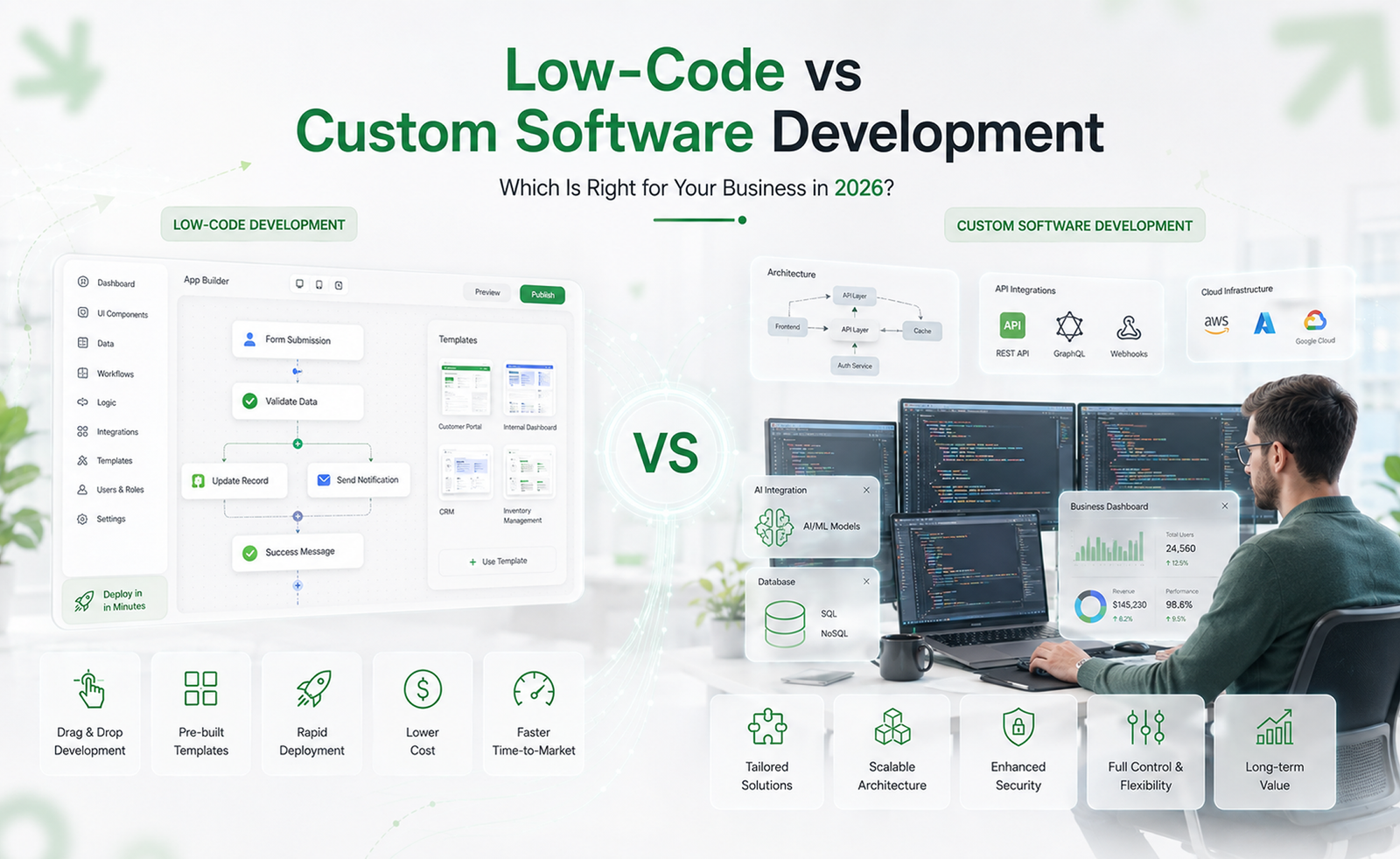
As businesses continue their digital transformation journey, choosing the right software development approach has become more important than ever. Organizations today need applications that improve efficiency, automate workflows, enhance customer experiences, and support long-term business growth. However, one common question many business owners face is whether to choose a low-code development platform or invest in custom software development.
Low-code platforms promise faster development with minimal coding, making them attractive for simple business applications and rapid prototyping. On the other hand, custom software development provides complete flexibility, scalability, and security, allowing businesses to build solutions tailored to their unique requirements.
Both approaches have their advantages, but the right choice depends on your business goals, budget, technical requirements, and future growth plans. Understanding the differences between low-code and custom software development helps organizations make informed technology decisions that deliver long-term value.
At Shweta Technologies, we help businesses evaluate their requirements and develop scalable software solutions that align with their operational needs, digital transformation goals, and future business strategies.
What Is Low-Code Development?
Low-code development is a software development approach that allows applications to be built using visual interfaces, drag-and-drop components, and pre-built templates instead of writing large amounts of code manually.
These platforms enable businesses to develop applications more quickly by reducing the amount of traditional programming required. Low-code solutions are particularly useful for creating internal business tools, approval workflows, dashboards, forms, and basic customer portals.
Common uses of low-code development include:
- Internal business applications
- Workflow automation
- Employee management systems
- Customer service portals
- Data collection forms
- Business dashboards
- Approval workflows
- Rapid application prototypes
Because much of the development process is visual, businesses can launch applications faster and reduce initial development time.
What Is Custom Software Development?
Custom software development is the process of designing, developing, and maintaining software that is built specifically for a business’s unique requirements. Unlike ready-made software or low-code platforms, custom solutions are developed from scratch, giving businesses complete control over features, functionality, integrations, security, and scalability.
Custom software is designed to solve specific business challenges rather than forcing organizations to adapt their processes to fit a generic platform.
Businesses commonly invest in custom software for:
- Enterprise Resource Planning (ERP) systems
- Customer Relationship Management (CRM) platforms
- E-commerce websites
- Mobile applications
- Healthcare management systems
- Educational platforms
- Financial software
- Manufacturing management systems
- AI-powered business applications
- Industry-specific enterprise solutions
Although custom software typically requires a higher initial investment, it offers significantly greater flexibility, long-term scalability, and competitive advantages.
Key Differences Between Low-Code and Custom Software Development
While both approaches aim to help businesses build digital solutions, they differ in several important areas.
Development Speed
Low-code platforms enable businesses to build applications quickly using visual development tools and pre-built components. Custom software development takes more time because every feature is designed and coded specifically for the business.
Flexibility
Low-code platforms provide limited customization based on the platform’s capabilities. Custom software offers complete flexibility, allowing businesses to implement any feature, workflow, or integration required.
Scalability
Low-code applications work well for small and medium-sized projects but may become limiting as business requirements grow. Custom software is designed to scale with the business, supporting increasing users, data, and complex operations.
Integration
Most low-code platforms support standard integrations with popular business tools. However, custom software can integrate with virtually any third-party application, internal system, or enterprise platform, making it ideal for organizations with complex technology ecosystems.
Security
Security features in low-code platforms depend on the platform provider and available configuration options. Custom software allows businesses to implement advanced security measures tailored to industry regulations and organizational requirements.
Ownership
With low-code platforms, businesses often depend on the vendor’s infrastructure, licensing model, and future updates. In contrast, custom software gives organizations full ownership and control over their application, data, and future development roadmap.
Benefits of Low-Code Development
Low-code development has become a popular choice for businesses that need to launch applications quickly while minimizing development effort. It is particularly suitable for simple workflows, internal tools, and rapid prototypes.
Key Benefits
- Faster application development
- Reduced development costs
- Quick prototyping and testing
- Easy workflow automation
- Minimal coding requirements
- Faster deployment
- Simplified maintenance
- Suitable for small and medium-sized projects
For businesses looking to validate ideas or digitize simple processes quickly, low-code platforms provide an efficient starting point.
Benefits of Custom Software Development
Custom software development offers unmatched flexibility, scalability, and long-term value. It enables businesses to build applications specifically designed around their operations, customers, and future growth plans.
Key Benefits
- Fully customized business solutions
- Complete ownership of the software
- Unlimited scalability
- Stronger security and compliance
- Better performance and reliability
- Seamless third-party integrations
- AI-ready architecture
- Long-term cost efficiency
- Competitive business advantage
- Future-proof technology
Although custom software requires a higher initial investment, it often delivers greater value over time by eliminating licensing limitations and adapting as the business grows.
Low-Code vs Custom Software Development
| Feature | Low-Code Development | Custom Software Development |
|---|---|---|
| Development Speed | Very Fast | Moderate |
| Initial Cost | Lower | Higher |
| Customization | Limited | Unlimited |
| Scalability | Moderate | Excellent |
| Security | Platform Dependent | Fully Customizable |
| Third-Party Integration | Standard Integrations | Unlimited |
| Ownership | Vendor Controlled | Full Business Ownership |
| Long-Term Flexibility | Limited | Excellent |
| Best For | Small & Medium Projects | Growing Businesses & Enterprises |
Which Option Is Best for Your Business?
The right choice depends on your business objectives, technical requirements, and long-term vision.
Choose Low-Code Development if you need:
- Rapid application development
- Internal business tools
- Workflow automation
- MVPs and prototypes
- Small-scale business applications
- Limited customization
Choose Custom Software Development if you need:
- Enterprise-grade applications
- AI-powered business solutions
- Complex workflows
- High security and compliance
- Unlimited scalability
- Long-term digital transformation
- Full ownership of your software
For growing businesses, custom software is often the better investment because it evolves alongside business requirements and provides complete control over features and future enhancements.
The Future of Software Development
Software development is moving toward a hybrid approach where low-code platforms accelerate simple projects while custom development powers mission-critical business systems.
Future trends include:
- AI-assisted software development
- Intelligent workflow automation
- Cloud-native applications
- API-first architectures
- AI-powered business platforms
- Hyperautomation
- Custom enterprise AI solutions
Businesses that invest in scalable, future-ready software today will be better positioned to innovate and compete in an increasingly digital marketplace.
How Shweta Technologies Helps Businesses
At Shweta Technologies, we help businesses choose the right development approach based on their goals, budget, and long-term growth strategy.
Our services include:
- Custom Software Development
- Enterprise Web Applications
- Mobile Application Development
- AI & Automation Solutions
- Business Process Automation
- Website Design & Development
- Cloud & Digital Transformation Consulting
Whether you need a rapid MVP, a business automation platform, or a fully customized enterprise solution, our team delivers scalable, secure, and future-ready software tailored to your unique business requirements.
Final Thoughts
Both low-code platforms and custom software development have their place in today’s digital landscape. Low-code offers speed and simplicity for straightforward applications, while custom software provides the flexibility, scalability, and control required for long-term business success.
Before making a decision, evaluate your business goals, operational complexity, future expansion plans, and integration requirements. Choosing the right development approach today can significantly impact your organization’s efficiency, customer experience, and competitive advantage in the years ahead.
👉 Visit: https://shwetatech.com/
Partner with Shweta Technologies to build secure, scalable, and innovative software solutions that support your digital transformation journey and drive sustainable business growth.
Contact Us
Shweta Technologies LLP
Ahmedabad, Gujarat, India
📞 +91 63561 37551
✉️ shwetatechnologie@gmail.com
🌐 https://shwetatech.com/